legacy wiki page - https://w.electrodragon.com/w/Category:Location#GNSS
location-dat - GNSS-dat - GPS-dat - nema-dat
Functions
boards
chip manufactures
software
Tesing
AT+CPIN?
+CPIN: READY

AT+CGNSPWR=?
+CGNSPWR: (0-1)

OK
AT+CGNSPWR?
+CGNSPWR: 0

OK
AT+CGNSPWR=1
OK

AT+CGNSINF
+CGNSINF: 1,0,19800109075159.000,,,,0.00,0.0,0,,,,,,3,0,2,,44,,

OK
AT+CGNSINF
+CGNSINF: 1,0,20240626075200.000,,,,0.00,0.0,0,,,,,,3,0,2,,44,,


AT+CGNSINF
+CGNSINF: 1,1,20240626074838.000,22.570777,113.887168,155.727,0.00,65.8,1,,2.8,3.0,1.0,,7,4,5,,47,,
- 2.1 AT+CGNSPWR GNSS power control ...................................................................... 8
- 2.2 AT+CGNSSEQ Define the last NMEA sentence that parsed ..................................... 9
- 2.3 AT+CGNSINF GNSS navigation information parsed from NMEA sentences ......... 11
- 2.4 AT+CGNSURC GNSS navigation, GEO-fences and speed alarm URC report ....... 12
- 2.5 AT+CGNSCMD Send command to GNSS ............................................................... 13
- 2.6 AT+CGNSTST Send data received from UART2 to UART1 ................................... 14
- 2.7 AT+CGNSCHK Check EPO file property ................................................................ 14
- 2.8 AT+CGNSDEL Delete EPO file ............................................................................... 15
- 2.9 AT+CGNSIPR Configure UART2 baud rate ............................................................ 16
- 2.10 AT+CGNSAID Send EPO file to GNSS engine ....................................................... 16
- 2.11 AT+CRFLOC Give reference location to GNSS engine ........................................... 17
- 2.12 AT+CGNSVER Query GNSS version....................................................................... 17
Note
Why you really need good GPS signal, compare to your smart phone?
- your smart phone use 4G network to assist the location, but GPS module use GPS-dat signal location only
- read more at AGPS-net
interface
cold, warm and hot start
GPS modules are outdoor positioning systems, so the antenna must be placed outdoors to get a fix. The first time you power on the module it performs a cold start and needs to download satellite data. This usually takes about 1–10 minutes, so please be patient.
Cold Start (冷启动)
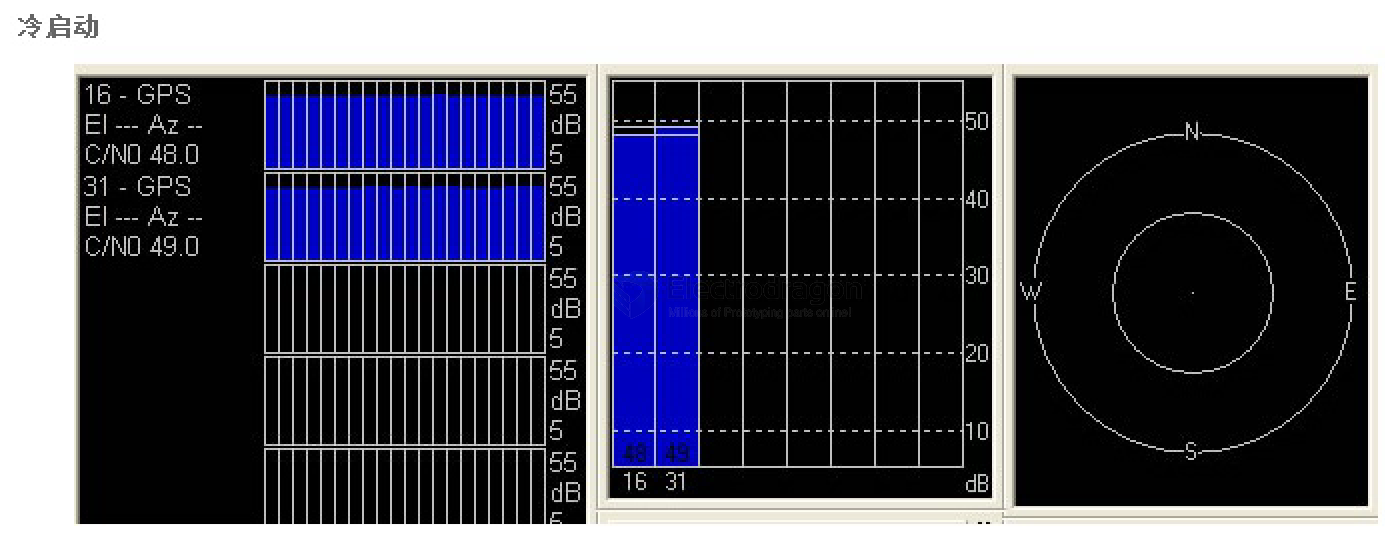
A cold start means the module has no stored ephemeris or almanac data internally. This is the very first startup, or any startup where all such data has been lost.
- Since there is no satellite orbit information available, the module must begin receiving signals and search the entire sky within the antenna’s view to find satellites and download ephemeris.
- During this first operation, the power consumption is high and the internal computation is complex, because it has to keep downloading the current effective ephemeris of the visible satellites.
- Cold-start sensitivity is lower. Without any prior ephemeris, the module cannot estimate its approximate position. It’s like arriving in a completely unfamiliar desert: you have no reference points, so you must scan the entire environment for landmarks to figure out where you are.
In other words, during a cold start, the GPS module has to do a lot of “wasted work”:
- It scans every corner of the sky like sifting signals through a filter.
- This process consumes a lot of power.
- Once it finds a satellite, it starts downloading ephemeris. If the signal condition changes (for example, you’re in a moving car and position changes constantly), the module may fail to download complete data and has to retry, which extends the cold-start time.
- In weak-signal environments, downloading ephemeris takes even longer.
You can compare this to downloading a file from the internet:
- If the connection is good, the file downloads quickly.
- If the connection is unstable, it may disconnect and need to re-establish the link, restarting or slowing the download.
- Users of CDMA / GPRS connections, especially on a train, know that the link can be intermittent and significantly worse than being near a base station.
Once the GPS module has continuously tracked three or more satellites, the situation improves:
- Like sketching a rough map in the field, you can at least estimate your approximate 2D position.
- At three satellites, 2D (horizontal) positioning becomes possible.
- At four satellites, you get 3D positioning (including altitude).
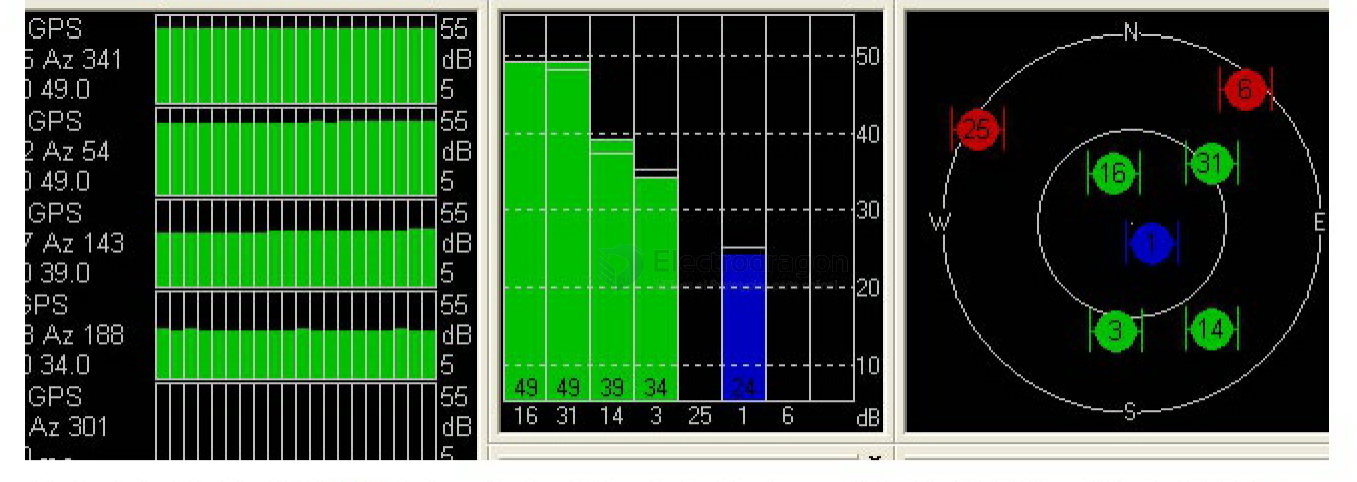
After the module has been running for a while and has finished downloading enough current information:
- It enters a relatively stable signal reception state.
- Small movements or moderate signal changes no longer affect it as much, because it has stored the current ephemeris data.
- Even with brief signal loss, it can rely on memory and internal calculations to quickly restore its position, just like someone who has become familiar with a new environment and can quickly find their way back.
Once stabilized:
- The ephemeris data continues to refresh periodically.
- After stabilization, the power consumption naturally decreases.
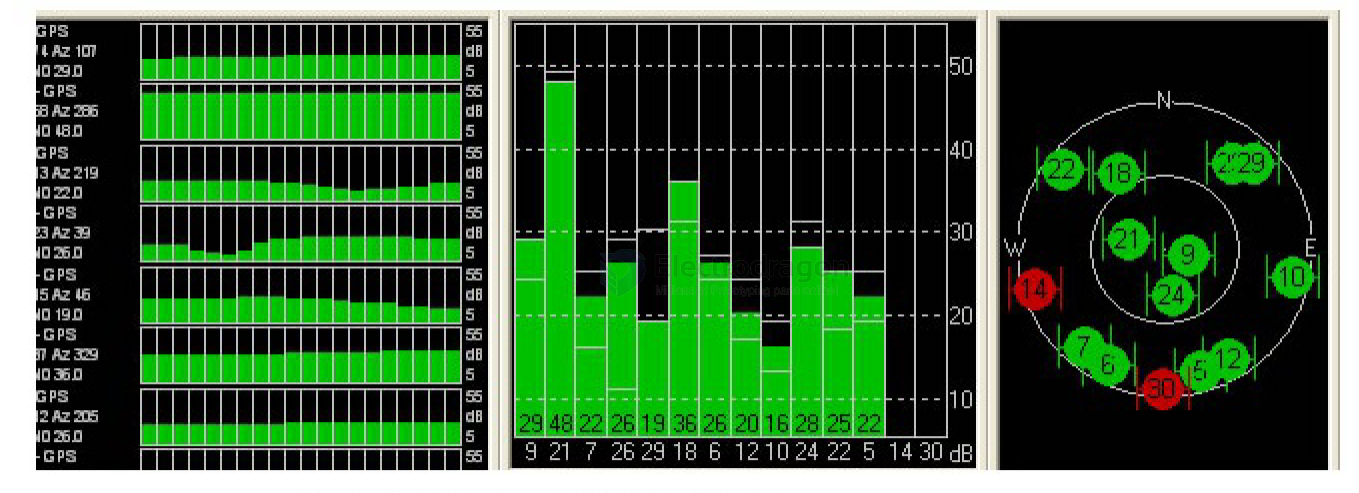
An analogy:
- The first time you visit a large amusement park (or zoo), you see elephants, monkeys, tigers, artificial hills, dense woods, etc. It’s dazzling and disorienting; you easily lose sense of direction.
- After wandering around all day, you become familiar with the terrain and realize the whole place isn’t that big.
- If someone then briefly covers your eyes and releases you, you can quickly figure out east/west/north/south.
Similarly, once the GPS module is in this familiar state:
- Even if you move into a weak-signal area from time to time, it can quickly readjust.
- Thanks to the stored ephemeris and internal calculations, the positioning performance is much better than during a fresh cold start in the same place.
You might wish that the module never had to go through cold start. In practice, we can shorten cold-start time by using network-assisted data, but some limitations remain:
- Through the internet, you can download almanac/ephemeris-like data (e.g. from u‑blox servers).
- However, ephemeris (星历) and almanac (历书) are different:
- Almanac is generated by u‑blox using data from about 182 ground receivers worldwide, then computing satellite orbits with software.
- Almanac files can cover 1 day, 7 days, 2 weeks, or even longer. In theory, with good almanac you can avoid a full cold start for long periods.
- In reality, satellite orbits are constantly corrected:
- Satellites’ actual paths change.
- Ground stations periodically adjust and correct the trajectory.
- So a “perfectly” computed almanac still has limited accuracy for precise positioning.
- Nonetheless, having good almanac/assistance significantly shortens cold-start time. Technologies like u‑blox A‑GPS or AssistNow are classic examples, but they require network connectivity, which is sometimes limited in real applications.
Hot Start (热启动)
If a cold start is the difficult process of adapting to a completely new environment, then a hot start is like living in a familiar place:
- You watch familiar TV, listen to familiar music, sleep in a familiar bed, and enjoy a pleasant, sunny day.
- We also hope that the module can “stay in a good mood”, i.e. remain familiar with its environment.
Practical meaning:
- Sometimes we need to briefly power off the GPS or the whole device.
- To allow the module to quickly return to its previous state when powered on again, we must save the current ephemeris and related data.
- This is done with a backup battery (后备电池), which can maintain the module’s data for about 8–12 hours.
If the main power is removed but the backup battery is present:
- And we reapply power within about 2 hours, the module can perform a hot start.
- In this case, it can reach a normal fixed position in about 3 seconds.
- The reason is that the satellite configuration overhead has not changed much:
- The satellites above your head have only moved slightly.
- It’s like walking near your home; the landmarks barely change, so you can quickly find your way back.
That small backup battery or backup supply can save you a lot of waiting time.
Warm Start (温启动)
Warm start is the case between cold and hot start:
- In practice, we don’t always restart within 2 hours.
- Suppose the main power to the module has been off for more than 2 hours, but the backup battery still has power.
- If we restart within 8 hours (approximate range) of power-off, the module will perform a warm start.
Characteristics:
- Startup speed is slower than hot start, but faster than cold start.
- Signal environment requirements are less strict than cold start, but stricter than hot start.
- The actual time needed to fix a position varies:
- The closer the time and satellite configuration is to the moment when data was last saved, the shorter the time to get a fix.
- The longer the power-off duration, or the bigger the change in satellite geometry, the longer it takes.
Analogy:
- The shorter the time you are away from home, the faster you re-familiarize yourself with your surroundings when you return—assuming your memory is fine.
- If you have been away too long, things change and your memory becomes less useful.
If enough time passes:
- For example, after 20 hours, the satellite configuration has changed significantly.
- The stored ephemeris is no longer very useful.
- In this case, the module effectively has to perform a cold start again.
Summary
- A computer is a machine that executes programs designed by humans; its “thinking” cannot exceed human logic.
- Many artificial intelligence products such as GPS systems are implementations of human-designed strategies based on natural rules.
- By understanding how our own thinking and memory work, we can design better and more efficient GPS behavior, especially around cold, warm and hot starts.