applications
how works
== voltage ladder
Vout = Vin * (R2 / (R1 + R2))
4.77V = 18V * (13K / (13K + 36K) )
3.65V = 18V * (13K / (13K + 51K) )

0.877V = 5V * (47K / (47K + 10K) )
0.526V = 3V * (47K / (47K + 10K) )

0.952V = 5V * (51K / (51K + 12K) )
0.571V = 3V * (51K / (51K + 12K) )
Vin == Vout * (R1 + R2) / R2
== 1V * (220K + 100K) / 100K
== 3.2V
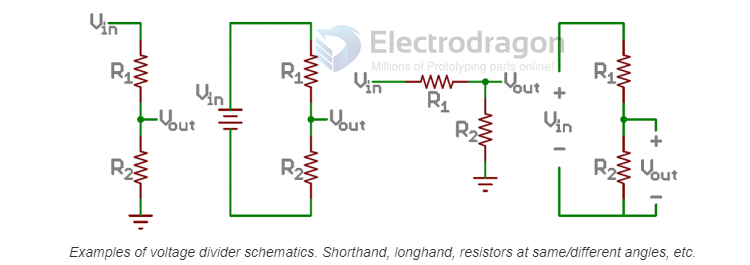
A voltage divider circuit is a very common circuit that takes a higher voltage and converts it to a lower one by using a pair of resistors. The formula for calculating the output voltage is based on Ohms Law and is shown below.
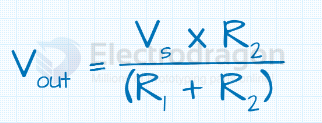
where:
- VS is the source voltage, measured in volts (V),
- R1 is the resistance of the 1st resistor, measured in Ohms (Ω).
- R2 is the resistance of the 2nd resistor, measured in Ohms (Ω).
- Vout is the output voltage, measured in volts (V),
NWI1118-dat on board ADC voltage ladder
cut off SJ3 first to use the ADC ladder.
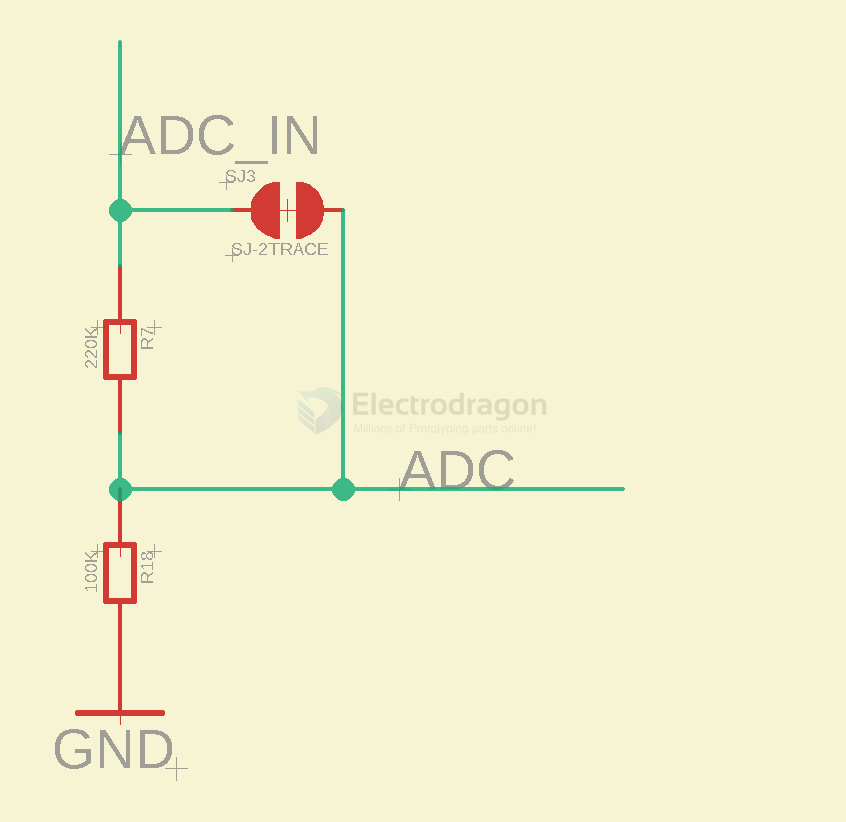
common use
VIN = 12V, R_up == 390K, R_down == 120K, Vout_mid == 2.8235V VIN = 11V, R_up == 390K, R_down == 120K, Vout_mid == 2.5882V