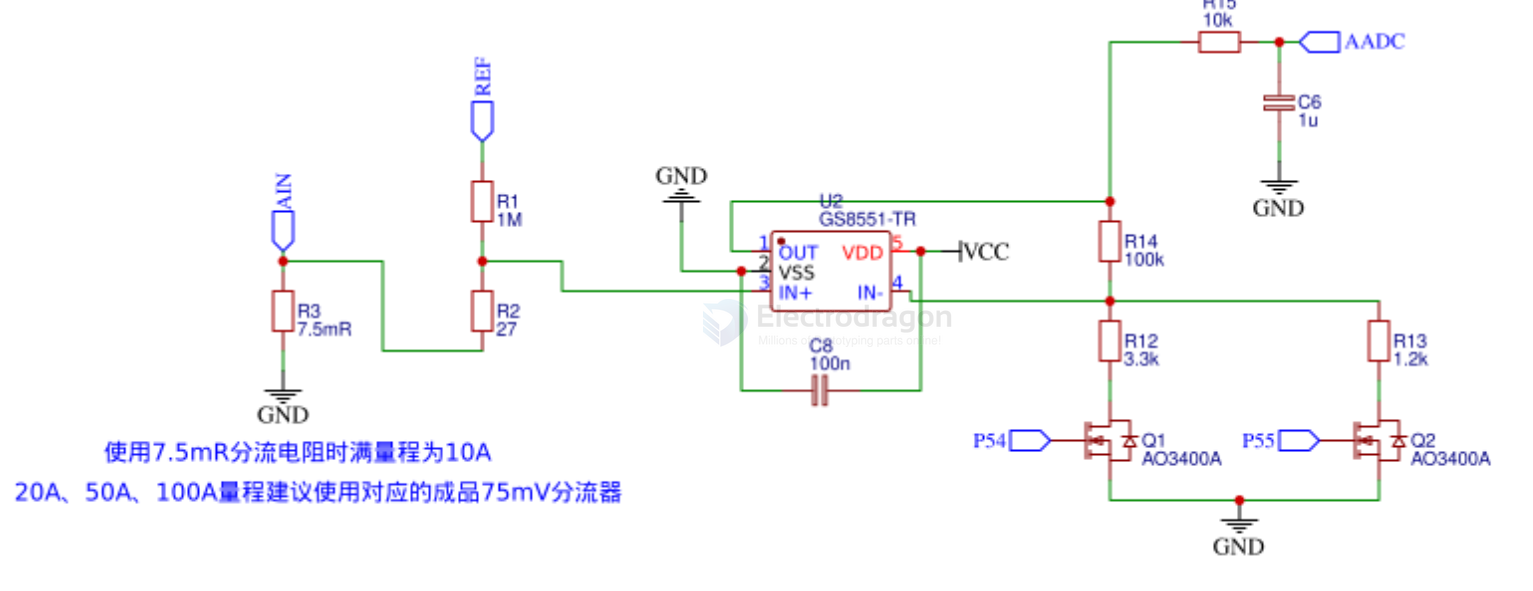
use meter-voltage-current-dat instead of meter-current-dat only
== memter am
== ammeter == ampere meter == current meter
sensor-voltage-dat - meter-voltage-dat - SVC1049-dat - SVC1017-dat
sensor-current-dat - meter-current-dat - SVC1022-dat - SVC1023-dat
board
meter-voltage-dat - SVC1019-dat - SVC1049-dat - SVC1017-dat - SVC1015-dat
meter-current-dat - 10A SVC1022-dat - 50A SVC1023-dat - 100A SVC1024-dat
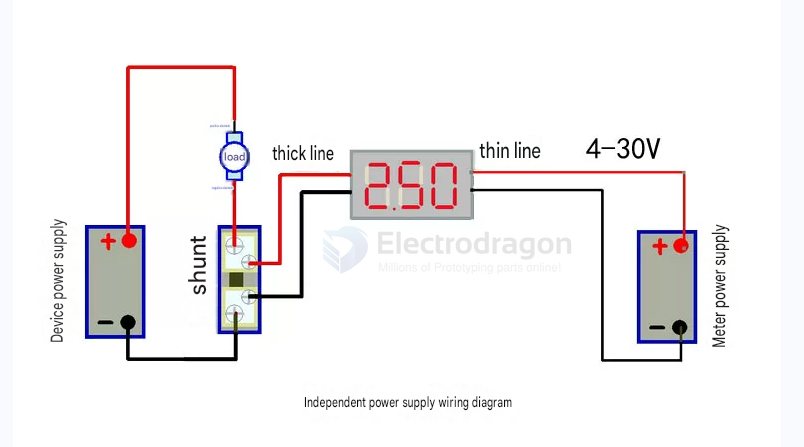
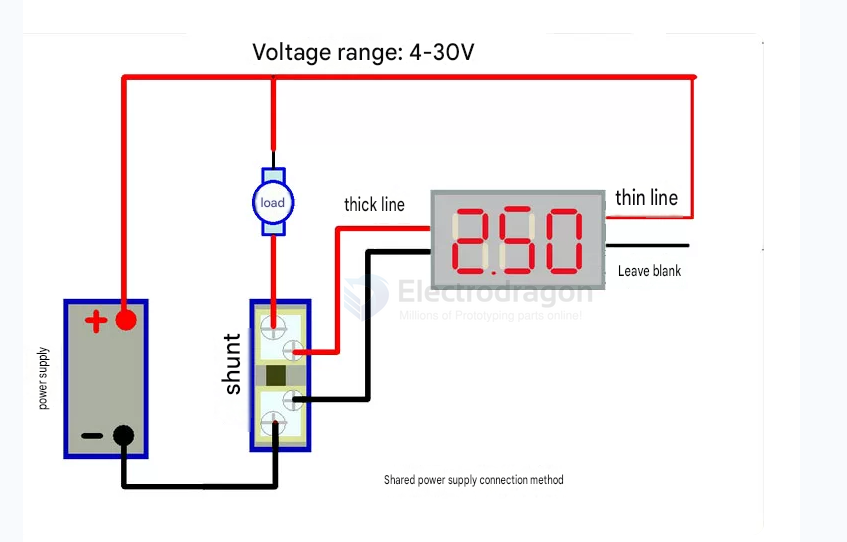
wiring
seperated power
Shared power
selection
When measuring current in embedded electronics and microcontrollers, you generally choose between a dedicated isolated Hall-effect sensor (like the ACS712) and a shunt resistor paired with an Analog-to-Digital Converter (ADC).
Here is a breakdown of why you would choose the ACS712 over a standard ADC-based shunt measurement setup.
1. Electrical Isolation (The Biggest Advantage)
- ACS712: It uses a Hall-effect sensor, meaning the high-current path being measured is physically and electrically isolated from the low-voltage microcontroller side (up to 2.1 kV RMS isolation). If your high-voltage side spikes or shorts, your microcontroller remains completely safe.
- Normal ADC Reader: A standard ADC measures current by reading the voltage drop across a shunt resistor ($\Delta V = I \times R$). Because the ADC pins must connect directly across this resistor, your sensitive microcontroller shares a common ground or electrical path with the high-current load. A massive surge can easily fry your chip.
2. Low High-Side Insertion Loss
- ACS712: The internal copper conduction path has an extremely low typical resistance of only $1.2\text{ m}\Omega$. This means it introduces negligible voltage drop into your target circuit and generates very little heat, even when running close to its maximum rated current (e.g., 5A, 20A, or 30A).
- Normal ADC Reader: To get a clean, readable voltage signal for a standard ADC without a massive amplifier, you often need a larger shunt resistor value. A larger resistance increases the voltage drop (burden voltage) across the sensor, robbing power from your load and generating unwanted heat ($I^2R$ losses).
3. High-Side and Low-Side Versatility
- ACS712: Because the sensing mechanism is based on magnetic fields rather than direct voltage reference, you can place the ACS712 anywhere in the loop—either on the high-side (before the load) or the low-side (after the load/before ground)—without changing your code or hardware topology.
- Normal ADC Reader: Standard microcontrollers have single-ended ADCs referenced to ground, making them naturally suited only for low-side sensing. Doing high-side sensing with a normal ADC requires specialized, expensive differential operational amplifiers (Op-Amps) that can handle high common-mode voltages.
4. Simplified Design (All-in-One Solution)
- ACS712: It is a fully integrated IC. It combines the internal current conductor, Hall-effect element, filter circuitry, and a precise internal amplifier into a single SOIC-8 package. You get a clean, linearized analog voltage output proportional to the current ($V_{out} = \text{Offset} \pm (\text{Sensitivity} \times I)$).
- Normal ADC Reader: Building a reliable shunt-based reader requires calculating precise resistor wattages, managing thermal drift of the shunt resistor, adding external operational amplifiers to scale the tiny millivolt drop up to the ADC’s dynamic range ($0\text{V} - 3.3\text{V}$ or $5\text{V}$), and implementing external filtering to kill high-frequency noise.
Comparison Summary
| Feature | ACS712 (Hall-Effect IC) | Normal ADC + Shunt Resistor |
|---|---|---|
| Electrical Isolation | Yes (Galvanic isolation up to 2.1 kV) | No (Direct electrical connection) |
| Measurement Position | High-side or Low-side seamlessly | Primarily Low-side (High-side requires extra components) |
| Component Count | Extremely Low (IC + 1 or 2 bypass caps) | High (Shunt resistor + Op-Amp + Filter network) |
| Circuit Power Loss | Extremely Low ($1.2\text{ m}\Omega$ internal path) | Higher (Depends on shunt resistor value) |
| AC/DC Capability | Measures both AC and DC natively | Measures both, but AC requires complex software rectifying/sampling |
When should you not use the ACS712?
While the ACS712 wins on isolation and simplicity, a standard ADC+Shunt setup is superior if you need extreme precision at very low currents (milliamps or microamps), or if your project is operating in an environment with high external magnetic interference (like right next to a massive brushless motor), which can throw off the Hall-effect sensor inside the ACS712.
SCH