info
The ESP32-P4 is Espressif’s high-performance, non-wireless SoC. It is designed for applications that require heavy computation, high-resolution displays, and complex user interfaces. Unlike the C6, the P4 is a "pure" microcontroller that focuses on raw power and I/O.
Comparison: ESP32-C6 vs. ESP32-P4
| Feature | ESP32-C6 (Connectivity) | ESP32-P4 (Performance) |
|---|---|---|
| Max Clock Speed | 160 MHz | 400 MHz |
| Cores | Single HP + Single LP | Dual HP + Single LP |
| Wi-Fi / Bluetooth | Integrated (Wi-Fi 6) | None (Requires external chip) |
| MIPI DSI / CSI | No | Yes |
| Video Encoding | No | Yes (H.264) |
| GPIO Count | ~30 | 55 |
1. High-Performance Dual RISC-V Cores
The P4 is the "muscle" of the ESP32 family. It moves away from the lower clock speeds of the C-series:
- Dual-Core HP CPU: Two RISC-V cores running at up to 400 MHz.
- AI & DSP Extensions: Includes support for specialized instructions that accelerate neural network processing and signal processing tasks.
- LP Core: A separate low-power RISC-V core (up to 40 MHz) for background monitoring.
2. Multimedia & Display Powerhouse
This is where the P4 is unique. It is the first ESP32 to feature dedicated hardware for modern screens and cameras:
- MIPI-DSI & MIPI-CSI: Native support for high-speed mobile industry processor interfaces. This allows you to connect high-resolution LCDs and camera sensors directly.
- H.264 Video Encoder: A hardware-based video encoder for recording or streaming video without taxing the main CPU.
- Pixel Processing Accelerator (PPA): A dedicated engine for image blending, scaling, and color space conversion (essential for smooth GUIs).
3. Massive I/O & Connectivity (Wired)
Since it lacks Wi-Fi, it provides professional-grade wired and peripheral options:
- USB 2.0 OTG: High-speed USB support for connecting thumb drives, keyboards, or acting as a high-speed device.
- Ethernet MAC: Integrated support for wired networking.
- 55+ Programmable GPIOs: Significantly more than the ~22–30 found on the C-series or S-series.
- SDIO 3.0 Host: For high-speed communication with SD cards or external Wi-Fi chips (like an ESP32-C6).
4. Advanced Security & Memory
- HP SRAM: A massive 768 KB of internal RAM, plus support for up to 32 MB of external PSRAM.
- Trusted Execution Environment (TEE): Hardware-level separation of secure and non-secure code execution.
The ESP32-P4’s performance-oriented design sets it apart, catering to applications where processing power and versatile peripherals are more critical than wireless connectivity.
本产品是一款基于ESP32-P4的多媒体开发板,并集成ESP32-C6,支持Wi-Fi6和BLE5无线连接。它提供丰富的人机交互接口,包括MIPI-CSI(集成图像信号处理器ISP)、MIPI-DSI、SPI、I2S、I2C、LEDPWM、MCPWM、RMT、ADC、UART和TWAI等。此外,支持USB OTG2.0HS,并板载4OPINGPIO扩展接口,兼容部分树莓派PicoHAT扩展板,实现更广泛的应用适配。ESP32-P4采用400MHz双核RISC-V处理器,支持最大32MBPSRAM,具备USB2.0、MIPI-CSI/DSI和H.264编码等外设,满足低成本、高性能和低功耗的多媒体开发需求。此外,ESP32-P4集成数字签名外设和专用密钥管理单元,确保数据与操作安全。ESP32-P4-WIFI6专为高性能和高安全应用设计,满足嵌入式系统在人机交互、边缘计算和IO扩展等方面的需求。
review 1
Personal impressions:
- This chip is neither outstanding nor lacking—somewhere in the middle.
- MIPI only supports 2 lanes.
- For Wi-Fi, you need to add a C6 module.
- Currently does not support Arduino.
Advantages:
- Mainly depends on future ecosystem development.
- Currently, there are quite a few comprehensive ESP-IDF examples, but individual module tests are still relatively few.
HDK
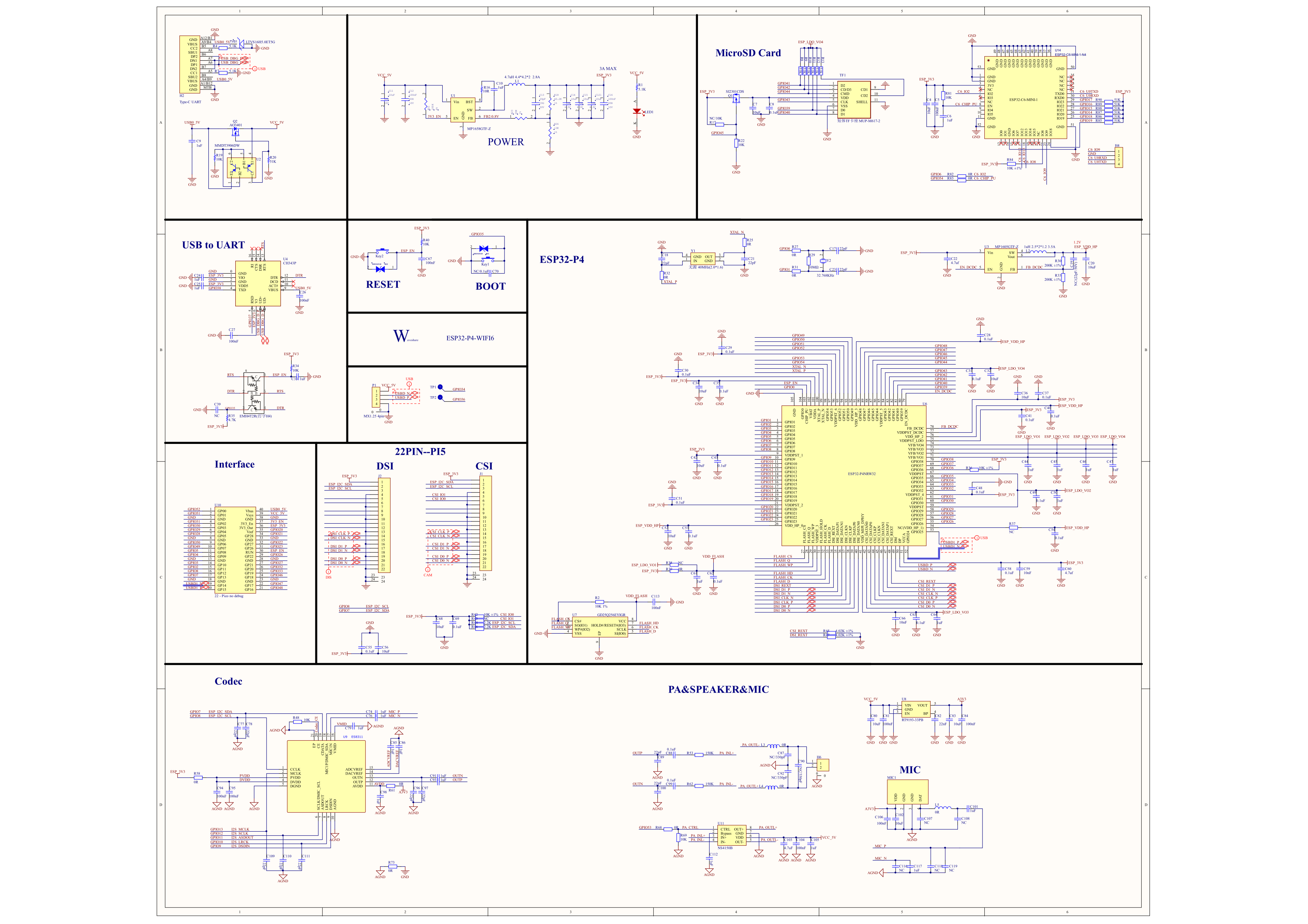
SCH
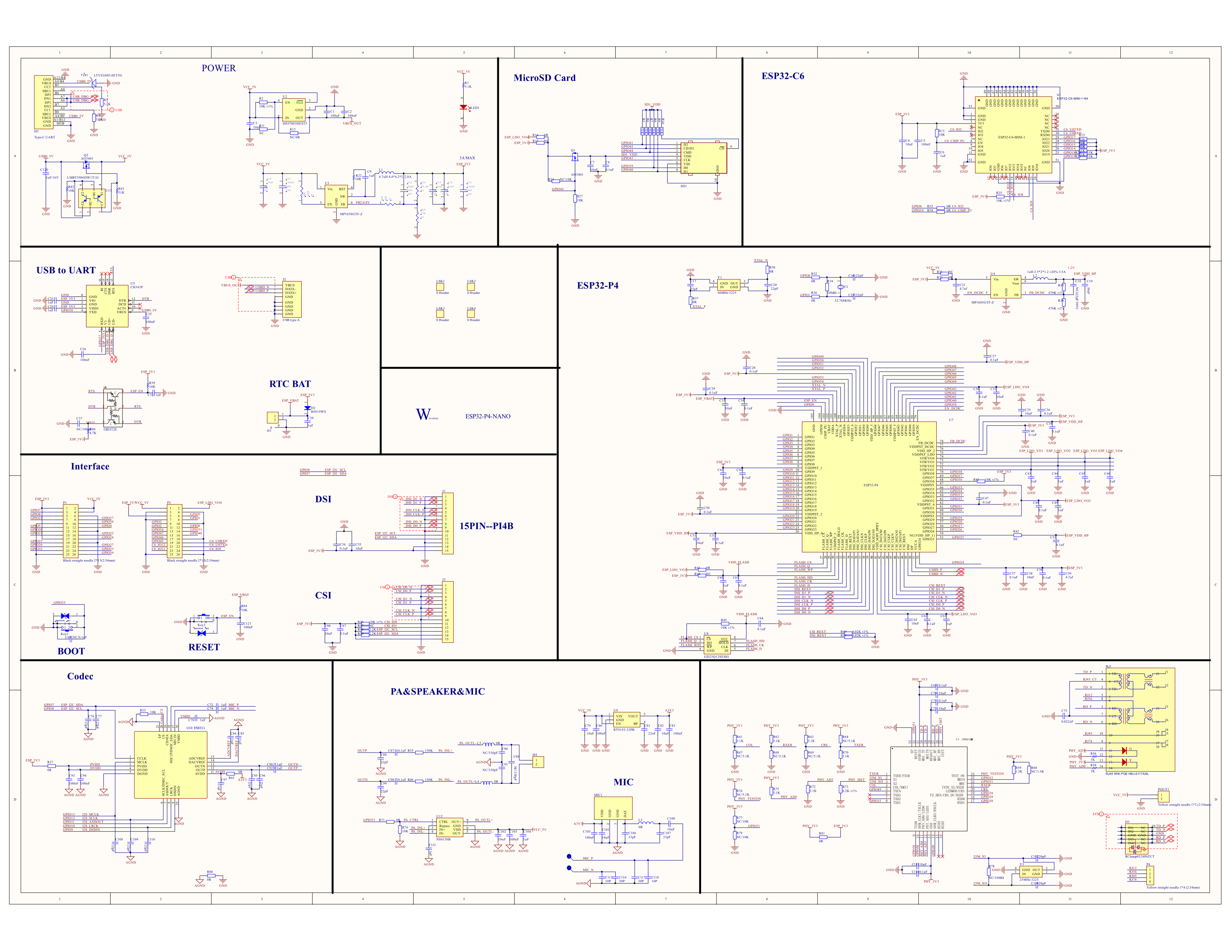
SCH 2