L type coupler

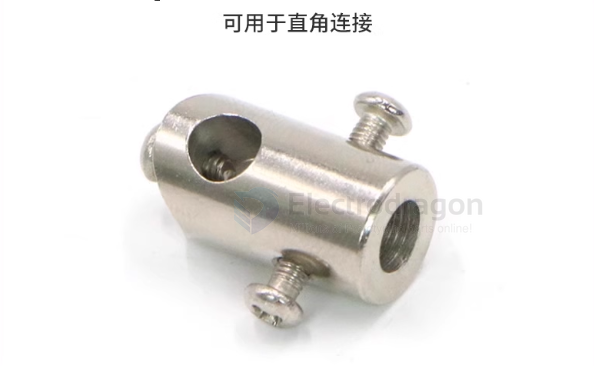
Shaft Coupler
A shaft coupler is a mechanical component used to connect two rotating shafts. It primarily functions to transmit torque while allowing for slight axial, radial, or angular misalignments.
Types of Shaft Couplers
1. Rigid Coupler
-
Features: No elasticity, provides a solid connection, requires precise shaft alignment.
-
Applications: High-precision CNC machines, industrial machinery.
2. Flexible Coupler
-
Features: Can absorb slight misalignment, reduce vibration, and minimize impact.
-
Common Types:
-
Jaw Coupling – Uses an elastomer insert to absorb vibrations; suitable for stepper and servo motors.
-
Bellows Coupling – High torque transmission capability, ideal for precision applications.
-
Disc Coupling – Used in high-speed and high-precision applications, such as robotics and aerospace.
-
Jaw Coupling – Uses an elastomer insert to absorb vibrations; suitable for stepper and servo motors.
3. Universal Joint (U-Joint)
-
Features: Allows for larger angular misalignment, commonly used for shafts that are not in perfect alignment.
-
Applications: Automotive drivetrains, heavy machinery.
4. Oldham Coupling
-
Features: Compensates for significant radial misalignment, commonly used in automation and 3D printing.
Key Functions of Shaft Couplers
✅ Torque Transmission – Connects the motor to the driven shaft for power transfer.
✅ Misalignment Compensation – Allows slight shaft misalignment, reducing stress.
✅ Vibration & Shock Absorption – Helps dampen vibrations and protect mechanical components.
✅ Equipment Protection – Some couplers act as safety devices in case of overload.
Why Diaphragm Couplers (Disk Couplers) Are Superior
Yes, a Diaphragm Coupler (also known as a Disk Coupler) offers significantly better gripping power than a standard set-screw coupler. For a high-torque project like your Rover V2, this is a professional-grade upgrade.
1. Clamping vs. Poking (The Grip Factor)
The primary reason it works better is the fixing method:
- Your Current Coupler: Uses a "Set Screw" that pokes a single point. On an aluminum tube, this just dents the metal and slips.
- Diaphragm Coupler: Most use a Clamping Design. When you tighten the side bolt, the entire inner circumference of the coupler shrinks to "hug" the shaft 360°.
- Result: The friction is distributed over the entire surface area of the shaft, making slippage nearly impossible.
2. Eliminating Backlash (Precision)
In robotics, you often have frequent "Start-Stop-Reverse" movements.
- The Problem: Set screws eventually wiggle and create "play" (backlash). Every time the motor reverses, the screw slams against the side of its hole, widening it.
- The Solution: Diaphragm couplers are Zero-Backlash. The torque is transmitted through thin stainless steel springs (the disks). There are no moving parts to "clatter," which keeps the connection tight forever.
3. Comparison Table: Why Upgrade?
| Feature | Entry-Level (Set Screw) | Diaphragm (Clamping) |
|---|---|---|
| Grip Strength | Low (Point contact) | High (Surface contact) |
| Shaft Damage | Heavy (Scratches/Dents) | Zero (Safe for Alu tubes) |
| Misalignment | Rigid (Causes vibration) | Flexible (Absorbs offset) |
| Longevity | Low (Screws loosen) | High (All-metal durability) |