Summary
An integral-formed hem (one-piece hem) is essentially: using machine capability to trade for consistency and reliability.
- Yes — the entry threshold is definitely higher.
- Not just slightly higher: it's a step up in difficulty and equipment requirements.
What is an integral-formed hem?
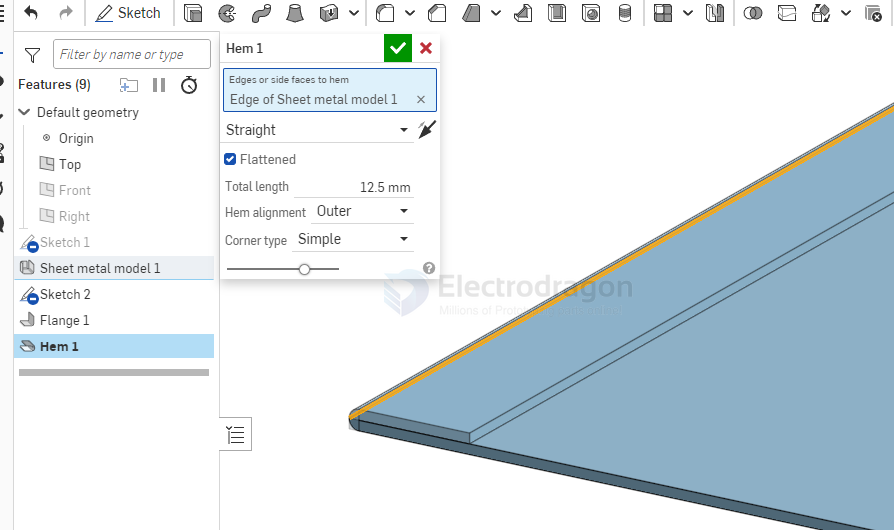
An integral-formed hem means folding the edge of the same sheet material back to 180° so the hem is formed from a single piece without adding separate parts. This requires stable, repeatable forming on the original workpiece.
Why the equipment threshold is higher
Forming a one-piece hem on the same blank imposes three hard requirements on the equipment:
- Progressive forming capability
- High repeatability (precision)
- Surface quality control
Quick comparison table
| Requirement | Why it matters | What the machine must provide |
|---|---|---|
| Progressive forming | A single aggressive bend will fail or be inconsistent | Multi-step forming with controllable angles and force |
| High repeatability | Hem radius, thickness, and straightness must be consistent part-to-part | High rigidity, accurate guiding, and precise positioning |
| Surface quality control | Avoid cracks, waviness, and tool marks on the hem and adjacent area | Dedicated forming tooling, smooth forming surfaces or rollers |
Detailed requirements
-
Progressive forming capability
- Do not form the hem in one hit. The process must be executed in multiple controlled passes with adjustable angles and loads.
- Ordinary press brakes or simple presses typically cannot achieve stable, repeatable one-piece hems.
-
High repeatability (precision)
- Every finished hem must match targets for:
- Radius
- Material thickness in the hem area
- Straightness/flatness of the hem and adjacent panel
- Equipment must be stiff, with precise guides and repeatable positioning.
- Every finished hem must match targets for:
-
Surface quality control
- Defects to avoid:
- Tearing or cracking
- Waviness or buckling
- Press marks or visible scoring
- Achieve this with specially shaped forming faces, rollers, or tooling that distribute force and protect the surface.
- Defects to avoid:
Key metrics to control
- Hem radius tolerance
- Hem cross-section thickness
- Local flatness / straightness near the hem
- Surface finish (no visible marks, scratches, or tears)
Common defects and causes
- Crack / tear — too aggressive a single bend or insufficient material flow control
- Waviness / buckling — uneven compression or lack of progressive forming
- Press marks / indentations — improper tooling surface or excessive local pressure
Equipment and tooling checklist
- Ability to program/perform multi-pass forming with controlled angles and loads
- High structural rigidity and accurate guides (for repeatability)
- Dedicated forming dies or rollers with smooth contact surfaces
- Means to control and measure part location consistently (fixturing, clamps)
- Process monitoring (force, stroke, angle) and ability to adjust on the fly
Process notes / best practices
- Use gradual, multi-stage bends rather than a single full-angle stroke.
- Match tooling geometry to material thickness and desired hem radius.
- Validate process with sample parts; measure radius, thickness, and flatness across samples.
- Inspect surface after each forming stage to catch defects early.