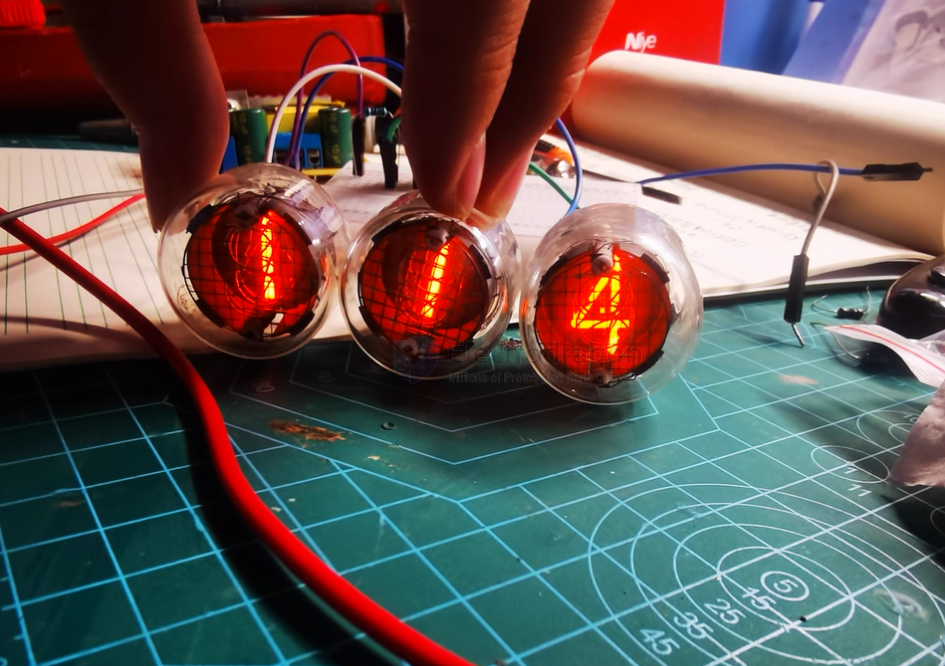
A Nixie tube is an electronic display device that uses cold cathode glow discharge to show numbers or symbols. It was widely used in the 1950s–1970s for calculators, instruments, counters, and clocks — before LED and LCD displays became common.
🧩 Working Principle
A Nixie tube is filled with a low-pressure inert gas (usually neon, sometimes with a little mercury or argon) and contains multiple cathodes shaped like numbers (0–9), plus a common anode grid.
When a high DC voltage (typically around 170V) is applied between the anode and one of the cathodes, the gas near that cathode becomes ionized and glows with an orange-red discharge, illuminating the selected number.
⚙️ Structure
| Component | Description |
|---|---|
| Glass envelope | Sealed tube, filled with inert gas |
| Anode mesh | A grid at the front, controlling current flow |
| Cathode digits | Metal wire shapes (0–9), stacked at different depths |
| Gas filling | Usually neon (Ne) with traces of mercury or argon |
| Pins | Electrical leads for circuit connection |
⚡ Electrical Characteristics
| Parameter | Typical Value |
|---|---|
| Ignition voltage | 150–180 V DC |
| Maintaining voltage | 120–140 V DC |
| Current per digit | 1–3 mA |
| Light color | Orange-red (from neon glow) |
💡 Applications
- Old digital instruments
- Counters and frequency meters
-
Nixie clocks (retro electronic clocks)
- Retro art and design projects
🕰️ History and Modern Revival
- Commercialized by Burroughs Corporation in the 1950s.
- Replaced by LED and LCD displays in the 1970s.
- Revived in modern times for vintage-style Nixie clocks and electronic art.
🔬 Nixie Tube vs. Vacuum Fluorescent Display (VFD)
| Feature | Nixie Tube | VFD |
|---|---|---|
| Light source | Gas discharge | Electron-excited phosphor |
| Voltage | High (~170V) | Low (~30V) |
| Color | Orange-red | Green or blue-green |
| Drive type | Individual cathode control | Grid + cathode matrix |
| Lifetime | Moderate (a few thousand hours) | Longer (tens of thousands of hours) |
🧠 Summary
A Nixie tube is a gas-discharge-based numeric display famous for its warm, vintage orange glow.
Though technologically obsolete, it remains popular among hobbyists and designers for its nostalgic beauty and craftsmanship.