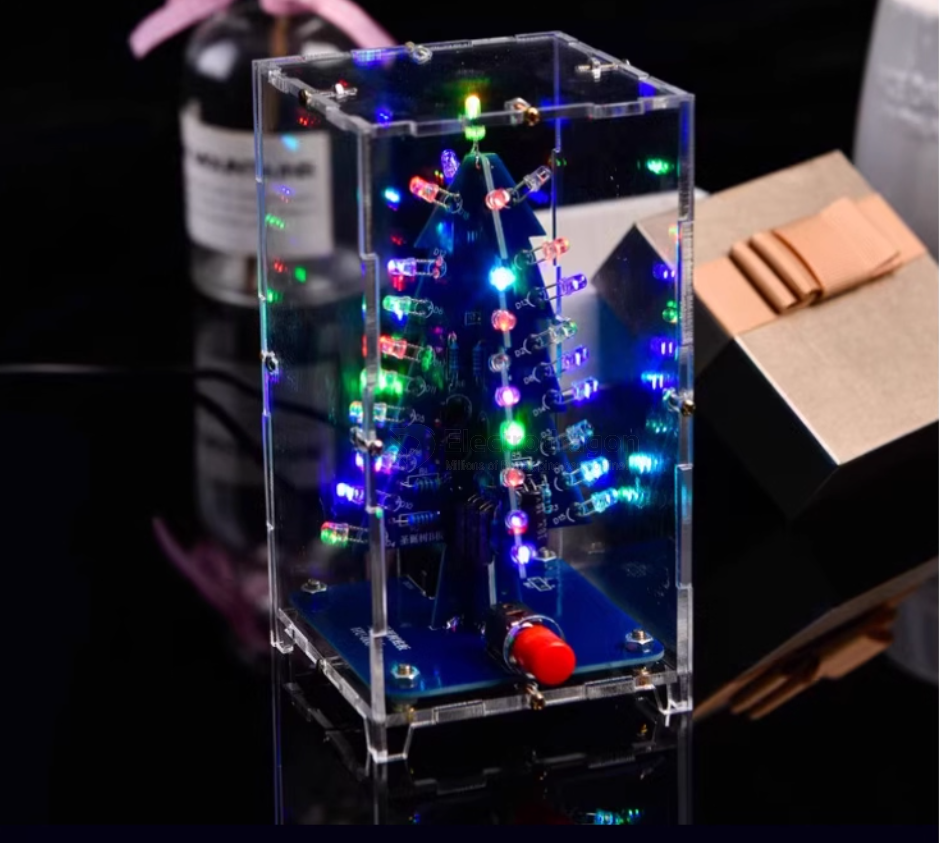
Working Principle
When powered by 3–5V, the 37 LEDs are divided into 4 groups. When the power is turned on, 4 transistors compete to turn on first. Due to component differences, only one transistor (let's assume Q1) turns on first:
Step-by-Step Operation
-
Q1 Turns On
- LED group 1 lights up.
- Q1's collector voltage drops.
- The left side of capacitor C2 drops close to 0V.
- Capacitor voltage cannot change instantly, so Q2's base is also pulled near 0V.
- Q2 is off, and LED group 2 is off.
-
Q3 Turns On
- Q2's high voltage passes through capacitor C3, raising Q3's collector voltage.
- Q3 quickly turns on, lighting up LED group 3.
- For a short time, both Q1 and Q3 collectors are low, so LED groups 1 and 3 are on, while group 2 is off.
-
Q2 Turns On
- Power charges C2 through resistor R2, Q2's base voltage gradually rises.
- When Q2's base voltage exceeds 0.7V, Q2 turns on.
- Q2's collector voltage drops, and LED group 2 lights up.
- Q2's collector drop passes through C3, lowering Q3's base voltage.
- Q3 turns off, its collector voltage rises, and LED group 3 turns off.
-
Cycle Repeats
- The circuit repeats this process, so the three groups of 18 LEDs light up in turn.
- At any moment, two groups are lit.
- The LEDs are arranged in a heart shape and flash in a flowing pattern for a dynamic display effect.