board
- STH1052-dat - soil moisture sensor board
working principles
The principle of detecting soil moisture is mainly based on measuring how the presence of water affects the electrical or physical properties of the soil. The most common types are as follows:
🌱 1. Resistive (Conductivity-Based) Principle
Principle:
The more water in the soil, the higher its conductivity (lower resistance) because water contains electrolytes. When the soil is dry, resistance increases.
How it works:
- Two metal probes are inserted into the soil.
- A small voltage is applied across them.
- The resulting current or resistance is measured and converted to moisture content.
Advantages: Simple, inexpensive, fast response.
Disadvantages: Electrodes corrode easily, affected by soil salinity, limited long-term stability.
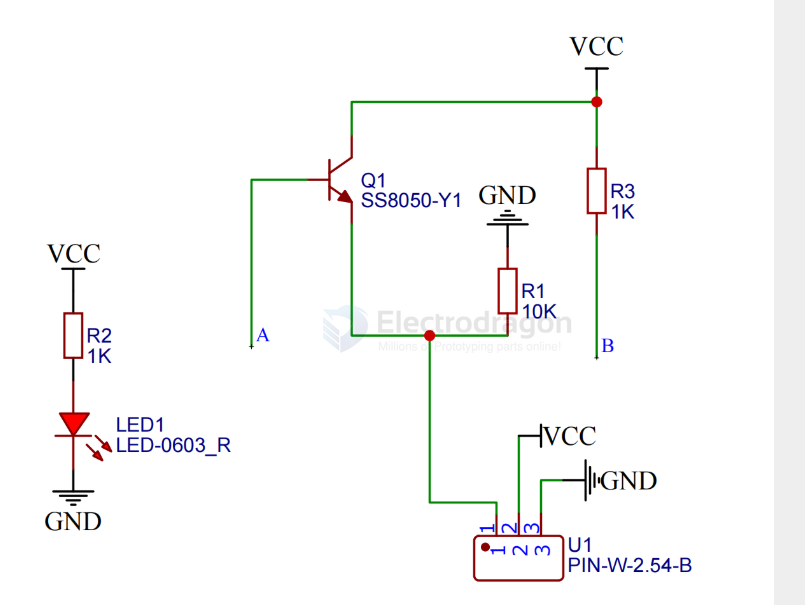
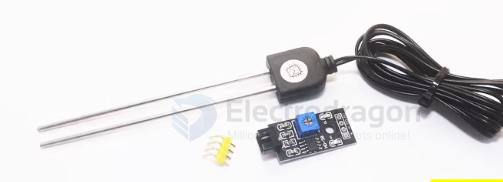
土壤湿度传感器模块有两个铜条是传感器探头,将它们插入土壤时,它们可以检测到土壤的水分,土壤湿润,导电性越好,反映出它们之间的电阻越低,土壤干燥,导电性就相对差一点,因此他们之间的电阻越高,它是模拟传感器,因此我们通过模拟输入获得电压值,因为土壤的湿度可以分为几个等级,当我们使用土壤湿度传感器做一个自动浇花系统的时候,将方便的使用。
SCH
code
void setup(){
Serial.begin(9600);
pinMode(A0, INPUT);
}

void loop(){
delay(1000);
Serial.println(analogRead(A0));

}
anti-rust probe
🌾 2. Capacitive Principle
Principle:
The dielectric constant of water (~80) is much higher than that of dry soil (~4) or air (~1).
As soil moisture increases, the dielectric constant of the soil rises, and the sensor’s capacitance increases.
How it works:
- The sensor forms a capacitor (with metal probes or plates).
- The capacitance change is measured and calibrated to indicate moisture level.
Advantages:
- No direct electrical contact with soil (non-corrosive).
- High stability, suitable for long-term monitoring.
Disadvantages:
- Slightly higher cost.
- Requires high-frequency measurement circuitry.
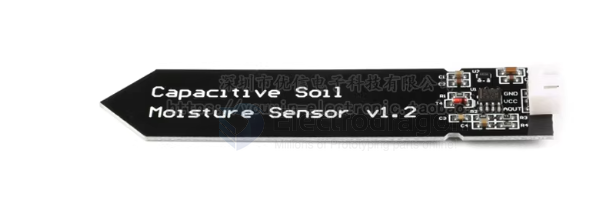
type of capacitive soil moisture sensor
新款土壤湿度传感器!这款电容式土壤湿度传感器区别于市面上绝大部分的电阻式传感器,采用电容感应原理来检测土壤湿度。避免了电阻式传感器极易被腐蚀的问题,极大地延长了它的工作寿命。
传感器内置稳压芯片,支持3.3~5.5V宽电压工作环境,这意味着即使在3.3V的主控板上,它也能正常工作。Raspberry Pi之类的微型PC,只需要外接一个ADC(模拟信号转数字信号)转换模块就可以工作。
外接一块屏幕,一块主板,你就可以和你的植物对话啦!看看心爱的它是不是渴了,需不需要多一点水的滋润。
- 工作电压: 3.3 ~ 5.5 VDC
- 输出电压: 0 ~ 3.0 VDC
- 湿度大时电压小,湿度小时电压大,请回去用万用表测量确认。
- 接口: PH2.54-3P
- 尺寸: 98 x 23mm (LxW)
🌿 3. Time Domain Reflectometry (TDR)
Principle:
The propagation speed of an electromagnetic pulse in soil depends on the soil’s dielectric constant, which varies with moisture content.
More water → higher dielectric constant → slower signal propagation.
How it works:
- A high-frequency pulse is sent along probes.
- The reflection time or waveform change is measured.
- The dielectric constant is calculated and converted into volumetric water content.
Advantages: Very accurate, measures volumetric water content.
Disadvantages: Expensive and complex equipment.
🍂 4. Neutron Scattering Method (Scientific Use)
Principle:
Fast neutrons are slowed down when they collide with hydrogen atoms (mainly from water molecules).
The number of slow neutrons detected indicates the soil water content.
Advantages: Extremely accurate.
Disadvantages: Very expensive, requires radioactive sources, strict safety requirements.
✅ Comparison Table
| Type | Measurement Basis | Accuracy | Cost | Stability | Characteristics |
|---|---|---|---|---|---|
| Resistive | Conductivity | ★★ | Low | ★ | Simple but corrodes easily |
| Capacitive | Dielectric constant | ★★★ | Medium | ★★★ | Stable, most commonly used |
| TDR | Electromagnetic wave velocity | ★★★★★ | High | ★★★★★ | High precision, research use |
| Neutron | Hydrogen atom count | ★★★★★ | Very High | ★★★★ | Laboratory / scientific use |